The U.S. Small Business Administration and the Signage Foundation for Communication Excellence ran the math: LED electronic message centers cost less than 15¢ per 1,000 exposures, versus $7–$15 for the same impressions on Facebook or Instagram in 2026. Here's how those numbers actually hold up — and what we've seen across 50+ installs in Jacksonville.
One of the most common questions customers ask before adding a digital display to their sign is whether the investment is actually worth it. It's a fair question. An LED electronic message center (EMC) is the largest single line item in most signage projects, and a business owner committing to one wants to know there's a return waiting on the other side. The good news: the math has been worked out, in public, by the federal government.
In 2001 the U.S. Small Business Administration and the Signage Foundation for Communication Excellence jointly published a study on Electronic Message Centres aimed at exactly this question — does a small business actually benefit from one, and by how much. The dollar figures in the report are a generation old, but the underlying math holds up surprisingly well. We've kept a copy on our site so you can read the whole thing for yourself; the marquee findings are below.
Cited source · public domain
Electronic Message Centres (EMCs): Signage for Your Business
Download the full studyThe SBA's core comparison is the one we lead every conversation with. Most advertising mediums are sold and evaluated on a "cost per thousand exposures" basis (also called CPM) — how many dollars you spend to put your message in front of 1,000 sets of eyes. Different mediums vary dramatically. Pulling together the SBA's 2001 figures with current 2026 benchmark CPMs:
| Advertising medium | Cost per 1,000 exposures | Source |
|---|---|---|
| Facebook / Instagram ads (small business avg.) | $7–$15 | Industry benchmark, 2026 |
| Google Display Network | $3–$10 | Industry benchmark, 2026 |
| Connected TV / streaming ads | $30–$50 | Industry benchmark, 2026 |
| Television (broadcast) | $6.26 | SBA, 2001 |
| Radio | $5.47 | SBA, 2001 |
| Newspaper (10-mile radius) | $7.39 | SBA, 2001 |
| LED electronic message center | < $0.15 | SBA, 2001 |
That number is not a typo. The SBA derived it from a straightforward scenario: spend $30,000 on an EMC with a ten-year useful life. Amortize the system cost across those ten years, add about 20¢ per day in electricity, and you get a daily operating cost of about $8.82. Position that sign in front of 20,000 vehicles a day — a typical commercial arterial — and your cost per 1,000 exposures works out to less than 45¢. With higher traffic counts, the per-thousand number drops further; with multi-message rotation, your effective reach per dollar climbs higher still.
Even the conservative version of that calculation puts an LED EMC at roughly one-fifteenth the cost of the next most efficient legacy medium (radio), and roughly one-fiftieth the cost of a typical small-business Facebook or Instagram campaign in 2026. We've never seen a media channel come close.
The dollar figures in the SBA study are dated, but the relative comparison is actually more favorable today, not less. LED hardware costs have dropped substantially — a comparable display now costs significantly less than $30,000 — while LED efficiency has improved, dropping electricity costs further. Meanwhile, the channels that have grown the most since 2001 — paid social, programmatic display, connected TV — have not gotten cheaper per impression. Most have gotten more expensive as auction competition has intensified. An LED EMC's relative advantage has widened, not narrowed.
The cost-per-impression math is interesting, but business owners don't make decisions based on impressions — they make decisions based on revenue. Here the SBA study cites a range that initially sounds aggressive: businesses adding an EMC typically see revenue increases of 15% to 150%.
Even at the bottom of that range, the numbers add up. The study walks through an example: a business doing $1,000 in revenue per day adds an EMC. Revenue increases by 15% — an additional $150 per day, or $1,050 per week, or $54,600 per year. That added revenue alone is roughly twice the cost of the entire EMC investment in year one. Even if you assume the increase is half that, the system pays for itself within twelve to eighteen months.
Why does it work? The SBA points to several reinforcing effects:
None of these effects are measured precisely in the study, but every one of them is consistent with what we've seen across the 50+ Daktronics LED installs we've done in Northeast Florida since becoming a Daktronics dealer in 2007. The pattern is so reliable that when a customer tells us an EMC didn't pay off, it's almost always traceable to a single cause: the messages weren't being changed. The hardware doesn't generate revenue by itself; the willingness to actually use it does.
The other thing customers ask, especially in commercial corridors near schools or residential areas, is whether an EMC is a driving distraction. It's a legitimate question and one the SBA study addresses directly, citing research that goes back to 1980.
The short version: there is no credible statistical evidence that properly designed electronic message centers reduce traffic safety. The first major study on this — commissioned by the Federal Highway Administration in 1980, with researchers Ross Netherton and Jerry Wachtel — set out to prove that variable message signs were unsafe. It found the opposite. The researchers reported "no credible statistical evidence" of negative safety impact and noted that roadside signs actually help maintain driver alertness by combating "highway hypnosis." Several state-level studies have followed; none have found an increase in accidents associated with EMCs, and some have found a decrease.
The SBA report also references a notable data point: when nine major insurance companies were surveyed, every one of them indicated they had never received an accident claim involving an advertising sign. In 1996 the Kentucky Supreme Court struck down a state statute restricting EMC content, finding the state had failed to demonstrate any legitimate safety interest served by the restriction. The Federal Highway Administration hasn't seen the need to revise its legality framework for on-premise EMCs since 1979 — provided the displays change at reasonable intervals and don't flash, the federal position is settled.
What matters for a business owner is the design discipline: a sign engineered with appropriate letter heights, brightness levels, hold-times between messages (typically 8 seconds or more), and dimming behavior is a traffic-safety contributor, not a hazard. Cheap or poorly programmed signs are different. This is one of the reasons we sell and install Daktronics specifically — their hardware ships with auto-dimming, hold-time controls, and brightness limits baked in by default.
It's not the right product for every business. The math gets compelling when a few conditions line up:
Decent vehicle traffic in front of the sign. The cost-per-impression math depends on volume. A business on a side street with 500 cars a day isn't getting the same return as one on a 25,000-car arterial. The SBA's 20,000-vehicles-per-day example is roughly the threshold below which the per-thousand math starts to weaken — though even at lower volumes, an EMC often still beats other advertising mediums.
Something worth saying that changes. Restaurants, fitness studios, auto dealers, churches, schools, fairgrounds, retail with frequent promotions — businesses that have a different best message on Monday than they do on Friday. A business with one message ("we're a law firm") doesn't get the same lift as one with a calendar of reasons to come in.
Permitting allowance. Some Jacksonville-area jurisdictions have specific restrictions on EMC size, brightness, hold-time, and proximity to residential. We work with these every week and can tell you in five minutes whether your specific location supports an EMC at all, and at what dimensions. Some sites that look perfect for one don't qualify; some sites that seem marginal actually do.
Willingness to actually program it. The most common reason an EMC underperforms is owner neglect of the content. We can install software that lets you schedule a year of content in an hour, but somebody on your end has to spend that hour. If nobody at the business is going to touch the system after install, the ROI calculation gets weaker — though even a static "this is the business name" EMC will outperform a non-illuminated reader board, so the math rarely goes negative.

Our first Daktronics install — Patrick's Uniforms & More, Garden City, Georgia. December 2007.
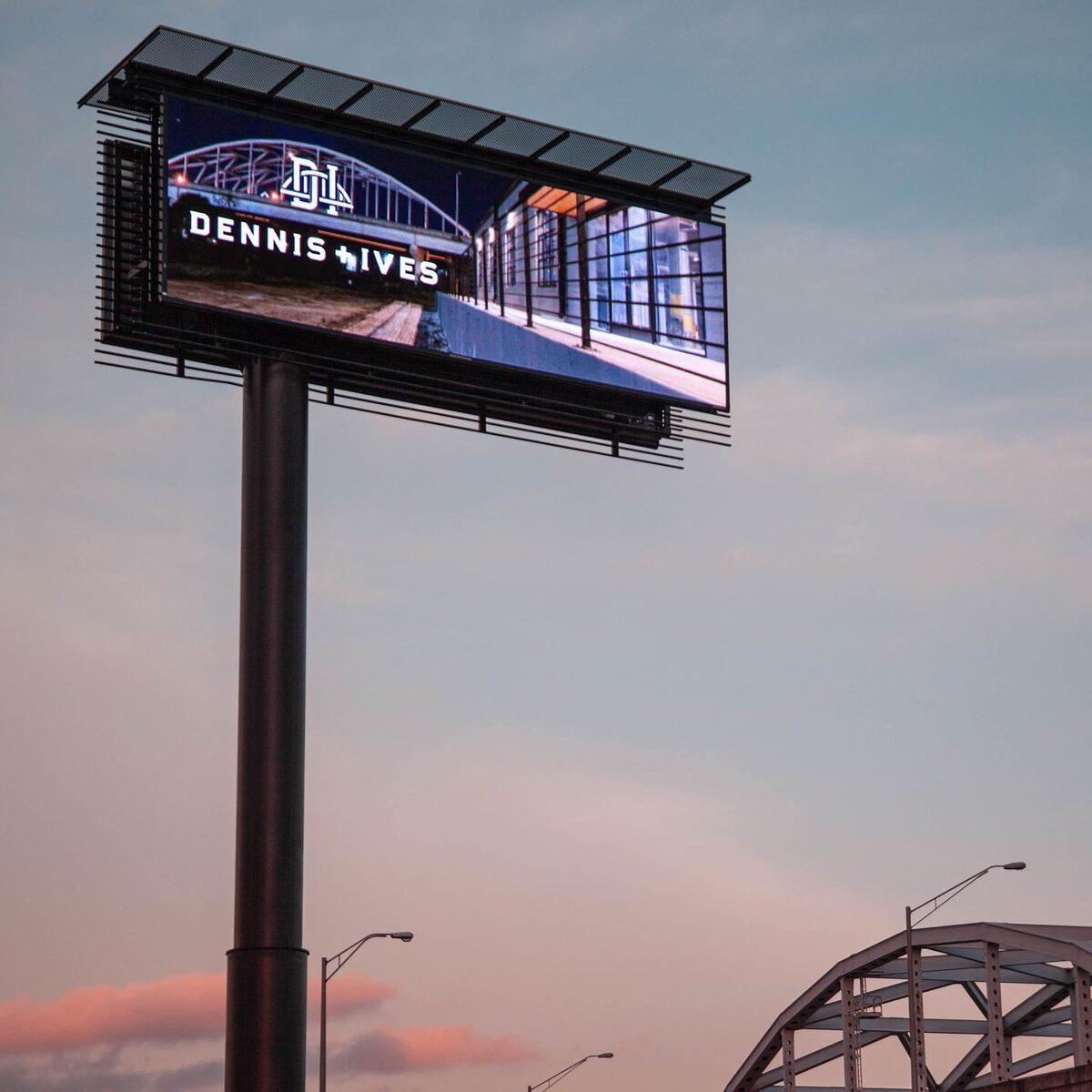
We've been a Daktronics dealer since 2007. The photo above is the first display we ever installed — a Daktronics Galaxy on a monument sign for Patrick's Uniforms & More, just before New Year's of 2007. Since then we've installed more than 50 displays across Northeast Florida — Fairgrounds, churches, banks, restaurants, automotive, healthcare, and the Dennis+Ives high-rise display on Dennis Street, visible from Interstate 95. After nearly two decades of watching these signs in the field, our honest perspective is that the SBA's findings broadly hold. The cost-per-impression advantage is real. The 15% revenue lift is conservative for most retail; we've seen restaurants and entertainment venues land closer to the high end of the SBA's range. The safety concern is genuine but addressable through hardware and programming choices that good displays handle by default.
The single biggest variable in whether an EMC pays off isn't the hardware brand, the pixel pitch, or even the location — it's whether the owner actually uses it. We try to set every customer up with that in mind: content templates, scheduling support, and (when wanted) ongoing content management. The math in the SBA study assumes you're putting it to work. When you are, the numbers land.
Want the source material?
Electronic Message Centres (EMCs): Signage for Your Business
Download the full studySend us your address and we'll come back with your specific traffic counts, zoning allowances for EMCs at that location, and a ballpark on hardware, install, and the cost-per-impression you should expect at your actual exposure volume. No commitment — just the numbers.
Get a Free Quote